At first glance grooming looks simple. Scissors, a clipper, a brush, a dryer — how hard can it be? But professional grooming is much more than a set of nice tools. A groomer needs to know coat types of different breeds, understand animal anatomy, use equipment correctly and, most of all, anticipate how the pet will react. That is why we do not recommend owners try complex procedures at home. Home care is a wonderful and necessary part of a dog’s or cat’s life. But there is a big difference between regularly brushing your pet and giving them a full DIY haircut.
What tools does a professional groomer use?
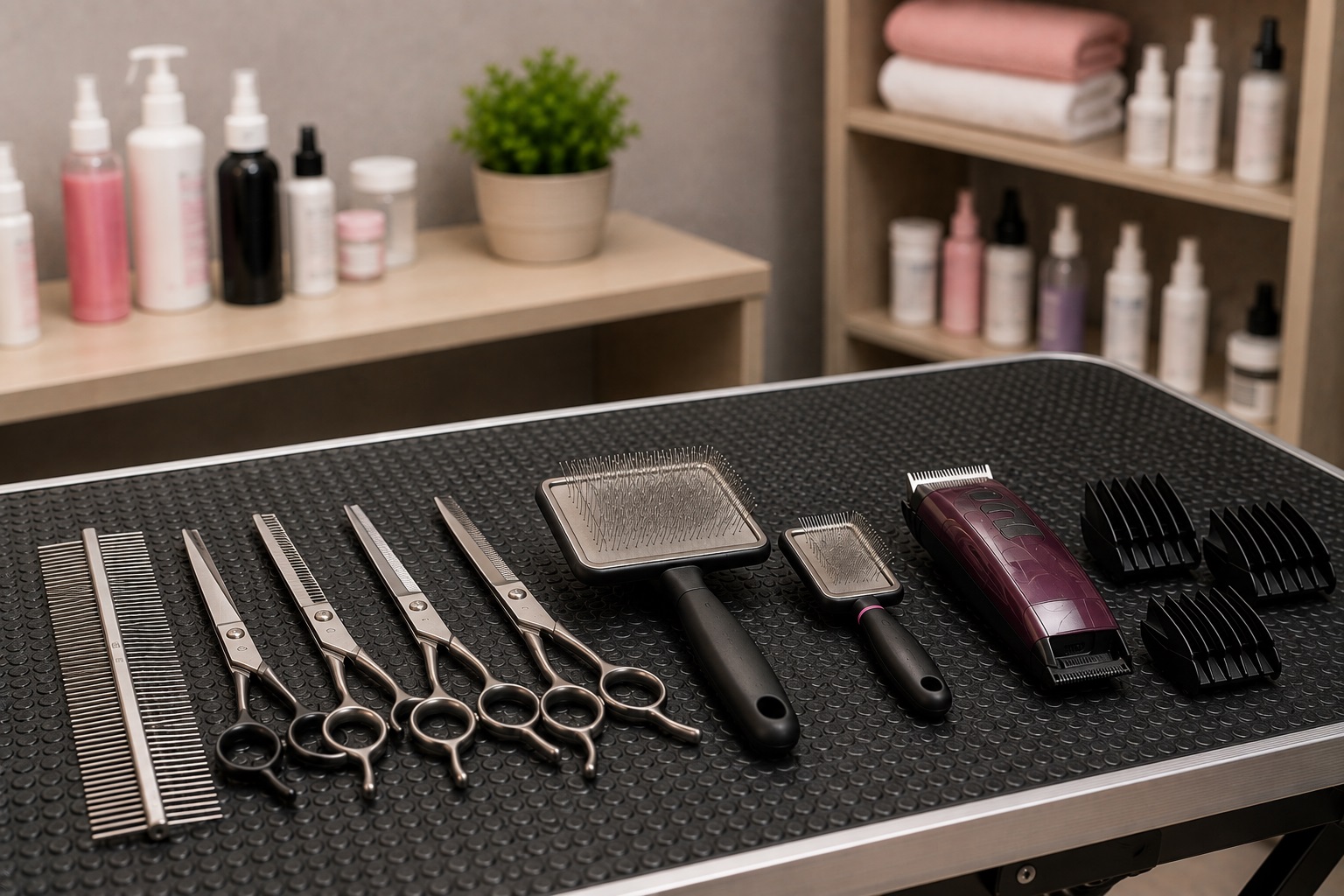
A groomer’s toolkit can differ a lot depending on breed and coat type. Among the main tools:
- scissors of different types;
- clippers;
- trimmers;
- combs;
- slicker brushes and other brushes;
- tools for working with mats;
- nail clippers;
- professional dryers and high-velocity dryers;
- special products for coat preparation.
And each tool has its purpose. A professional groomer does not simply grab whatever is closest. They assess the coat, its structure, skin condition, length and the desired result — and only then decide what to use and how.
Scissors: one of the most dangerous tools in a beginner’s hands
Even ordinary human hairdressing scissors need technique. Now imagine the client does not sit still in front of a mirror, but may suddenly turn their head, pull a paw or try to escape. That is why scissor work near the muzzle, eyes, ears and paws needs special care. A professional groomer knows how to hold the tool, at what angle to work and how to control the coat without creating extra stress for the animal. The worst place to learn scissors is your own pet. Especially around the face.
A clipper is not just “running it over the coat”
A clipper may seem the most straightforward tool. But cut length is far from the only question. You also need to consider:
- coat type;
- direction of growth;
- skin condition;
- blade or comb length;
- blade temperature;
- skin folds;
- breed specifics.
Wrong clipper use can mean an uneven cut, skin irritation or accidental injury. And the same technique does not fit a Yorkshire Terrier, a Pomeranian, a Shih Tzu, a Poodle and other breeds.
Even a slicker brush needs proper technique
A brush seems completely safe. But even a slicker can injure skin if you press hard or go over the same spot too many times. Be especially careful with thin, sensitive skin. Correct brushing is not a fight with the coat. The groomer’s job is to remove dead hair, detangle and prepare the coat for further care — without hurting the animal.
What about mats?
Mats are often what start DIY experiments. An owner sees a small clump and grabs scissors. That is where serious trouble can begin. A mat often sits very close to the skin. Through it you can hardly tell where hair ends and skin begins. Cutting it out quickly with scissors can end in a cut. If the coat is badly matted, better see a groomer. A specialist will assess the situation and choose the safest way to fix it.
Nail clippers: a small tool with big responsibility
Nails deserve a separate mention. Inside each nail are blood vessels and nerve endings. Cutting them wrong can cause pain and bleeding. An experienced groomer knows how much length is safe to remove and how to work with nails of different shapes and colours. If you are unsure of your skill, ask a specialist to show the right technique or leave the procedure to a professional.
A dryer is a professional tool too
After bathing, the coat must be dried properly — especially for dogs with dense or long hair. Professional grooming dryers can be very powerful. Wrong airflow or overly hot air can frighten the animal or cause discomfort. A groomer gradually introduces the dog to the noise and controls the drying process. So professional drying is not just “blow-dry until dry”. It helps prepare the coat for brushing and finishing.
Why a professional works with more than tools
Here is the main difference. A tool alone does not make a groomer a professional. You can buy the most expensive clipper, professional scissors and a full set of brushes. That does not mean the result will match a specialist’s work. A groomer needs to know:
- how to handle different breeds;
- how to prepare the coat;
- how to bathe and dry correctly;
- how to work with mats;
- what clip length to choose;
- how to work safely near eyes and ears;
- how to notice that the animal is tired or nervous;
- when it is better to stop the session.
And most important — a groomer does not work with hair alone. A groomer works with a living animal.
Can you care for your pet at home?
Of course! Home care matters a lot. An owner can regularly:
- brush the coat;
- check the skin;
- care for hair around the eyes;
- keep paws clean;
- watch nail length;
- get the animal used to touch and hygiene routines.
That does not replace professional grooming, but it complements it perfectly. The better you care for the coat between visits, the easier and more comfortable the next salon session will be.
When you should not experiment
There are situations when home grooming is better postponed. For example, if:
the coat is badly matted;
the animal will not let you touch certain areas;
you need scissors near the eyes or ears;
a complex breed clip is required;
you have never used a clipper;
nails are badly overgrown;
there is redness, sores or other unusual skin changes.
In those cases it is better not to risk your pet’s health and comfort. And if you suspect a skin disease or another health issue, see a veterinarian.
Professional grooming is not about expensive tools
You can buy a great home-care kit. But a groomer’s main tool is knowledge and experience. A professional understands when to use a clipper, when scissors, when a brush — and when it is better to do nothing yet. They see the difference between a normal coat and one that already needs special attention. And they work so the procedure stays as safe and comfortable as possible for the animal.
A final word
We are not asking owners to drop home care. On the contrary — regular home care is very important. But there is a line between care and experiment. Brushing your pet at home is great. Cutting out a tough mat next to the skin yourself, or picking up a clipper for the first time to try a full haircut, is a completely different story. So leave complex procedures to a professional. At Star Grooming we work not only with tools — we work with temperament, coat and the individual needs of every pet.